Late Starters, Big Leaps: Inside Kikuta's Adult Ballet Classes for Total Beginners
There's a particular sound in a beginner ballet studio about ten minutes into class: a room full of adults exhaling at the same time. Not because anything is hard yet. Because they've realized no one is going to yell at them.
Adult ballet enrollment has been climbing steadily across the US for years now, fueled partly by the barre-fitness boom and partly by something simpler — grown-ups wanting a physical practice that isn't a competition. Kikuta's adult beginner program has grown alongside that wave, and the people filling those spots are not former pre-professional dancers shaking off rust. Most of them have never taken a dance class in their lives.
Who Actually Shows Up
Sit in on a Tuesday evening session and you'll meet a pretty wide cross-section: a hospital nurse in her forties, a software tester who played travel soccer through college, a retired schoolteacher who always wanted to try and finally decided this was the year.
"I thought I'd be the oldest person and the worst person," says Marisol, 51, who started in Kikuta's beginner track after a knee injury ended her running habit. "I was neither. That was a genuine surprise."
Instructors say the average first-time adult student arrives with two assumptions that need dismantling: that ballet requires a specific body type, and that starting late means starting behind.
"Nobody's behind," says one of Kikuta's adult faculty. "There's no timeline you missed. You're not competing against a nine-year-old who started in 2015. You're learning a skill, at your pace, with an adult brain that can actually understand what the corrections mean."
That last part is worth sitting with. Adult learners tend to grasp anatomy, alignment, and musicality faster than kids do. What they lack in flexibility and muscle memory, they often make up for in focus.
What a Beginner Class Really Looks Like
If you're picturing a line of adults attempting fouettés, relax. Kikuta's beginner sequence is built in layers.
The Warm-Up (10 minutes)
Floor work first — ankles, hips, spine. No barre yet. Instructors use this time to teach breathing patterns that come back later during center work, which sounds small but ends up being the thing students say helps most on stressful days.
Barre (25 minutes)
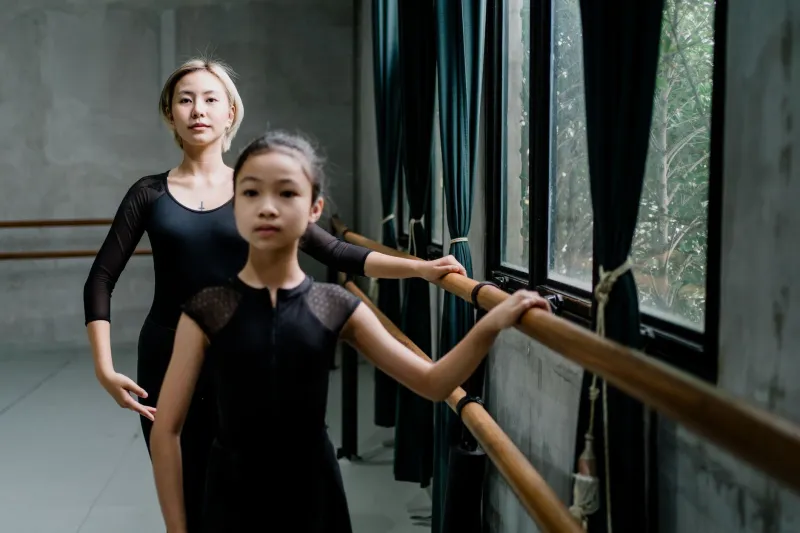
Traditional exercises, scaled for adult bodies. Pliés and tendus form the spine of it. Here's the key detail: the class learns two versions of almost everything. One version keeps both feet on the floor. The other lifts the working leg to a height that's realistic for a beginner. Nobody announces which one they're doing, and instructors don't single anyone out.
"We call it the menu," one teacher explains. "You pick what your body can do today. Tomorrow it might be different. That's not failure, that's just Wednesday."
Center and Traveling (20 minutes)
Simple combinations — a balancé, a pas de bourrée, a walking phrase across the floor. Expect to feel awkward. Expect to laugh. Expect the person next to you to be equally lost, which turns out to be a bonding experience.
Cool-Down and Repertoire Moment (5 minutes)
Each class ends with a short phrase set to music the instructor picks — sometimes classical, sometimes a slow soul track. It's the closest thing to performing you'll get in month one, and it's designed to feel good rather than impressive.
The Joy-Over-Perfection Rule
Kikuta's adult classes operate on an explicit principle: technique matters, but the point is showing up, not nailing it.
Practically, that means:
- No mirrors at the front of the room. Mirrors are on the side walls only. Instructors want students feeling the movement before they start policing it visually.
- Corrections are invitations. You can take one or wave it off. No follow-up questions.
- No recital requirement. Adult students who want to perform can. Adult students who'd rather stay in class can also do that.
- Small class caps. Enough people for energy, few enough that nobody hides in the back row.
Getting Started Without Overthinking It
If you're considering a first class, here's the practical version:
- Wear something you can move in. Leggings or athletic pants, a fitted top, and socks with a little grip. No need to buy ballet slippers before your first session — many studios, Kikuta included, have loaner pairs.
- Eat something light an hour before. Ballet class is more cardio than it looks, especially center work.
- Tell the instructor it's your first time. They'll keep an eye out without making a thing of it.
- Skip the comparison game. The person next to you has their own weird knee, their own tight hamstring, their own reason for being there.
- Give it four classes before you judge it. The first one is mostly orientation. The fourth is when it starts feeling like yours.
Why This Trend Has Legs
Adult beginner dance isn't a flash in the pan. Studios from Austin to Chicago to Brooklyn have added or expanded adult tracks, and the demand keeps coming from people who want a hobby that's physical, structured, and unplugged for an hour.
What makes Kikuta's approach notable is that it doesn't treat adult beginners as a revenue sideline or a fitness substitute. The curriculum is sequenced, the faculty is trained for adult learners, and the culture is deliberately low-pressure.
"I came in thinking I'd be embarrassed," Marisol says. "Six months later I'm the one telling new people it's fine. That's the whole thing. It's fine. It's actually fun."
If a new year's resolution list has been sitting on your phone since January with 'try something new' on it, this is a low-risk place to start. One class, soft socks, no expectations. The barre will still be there next week.